Ancient curiosities
Word games, as we know them, started to develop with the spread of literacy in the 19th century. Before that, only a tiny part of the population could read and write.
There is no evidence, that ancient scribes played word games, but at least some of them seem have played with words.
This is illustrated by two curiosities from the ancient world:
- Palindromes
- The word square and in particular the SATOR square
Neither of these can really be considered as word games, but they do show a playful approach to words and writing.
Palindromes
A palindrome is a sentence, which reads the same forwards and backwards, like
Was it a cat I saw
Creating palindromes is not exactly a word game, but rather a kind of Wordplay.
Scholars think that palindromes originated in ancient Greece, although the oldest known example is in fact Roman.
Νίψον ἀνομήματα μὴ μόναν ὄψιν
The most famous palindrome in Greek is:
Νίψον ἀνομήματα μὴ μόναν ὄψιν
or
Nipson anomēmata mē monan opsin
which means
Wash your sins, not only your face.
This inscription is found at multiple sites, including this one at the monastry Panagia Malevi in Greece.
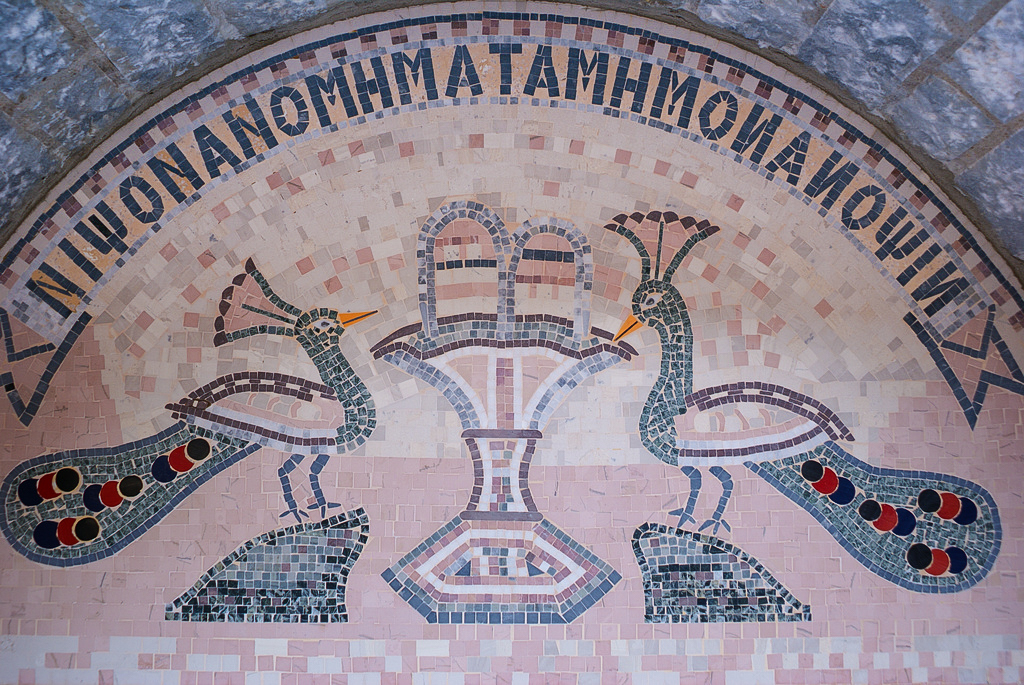
ΝΙΨΟΝ ΑΝΟΜΗΜΑΤΑ ΜΗ ΜΟΝΑΝ ΟΨΙΝ inscribed at the monastery Panagia Malevi
Licensed under the Creative Commons Attribution 2.0 Generic license. Image available here.
.jpg)
In this example, the final letter N is written backwards, making the phrase into a Mirror Ambigram. This means that it reads the same in a mirror image.
Word Square
A word square is a square grid containing words of the same length, so that you can read the same words horizontally and vertically.
Here's a simple example using 4 letter words:
and here'e one using 5 letter words:
It's fairly easy to create a word square with 4 letter words, but gets much harder with longer words.
My tip is to look at where the vowels are. This grid shows the position of the vowels in the 4-letter word square above.
You can see that the pattern looks a bit like a checker board, but not quite. This is quite natural, because in a lot of words, the vowels and the consonants alternate.
For every vowel in the first word, there will have to be a word starting with that vowel. In this pattern there is only one word which starts with a vowel. To get started, I would pick a word for this position, let's say EVER.
Now we need a first word which starts with two consonants, for example GREW, BLEW, WHEN, THEM or STAY. Let's choose THEN.
The second word can be HAVE and finally, we could choose NERD as the final word.
That's an amusing pastime, but the really amazing thing is the history of the word square, which dates back to ancient Rome.
The SATOR square
The SATOR square is word square consiting of the five Latin words:
- SATOR
- AREPO
- TENET
- OPERA
- ROTAS
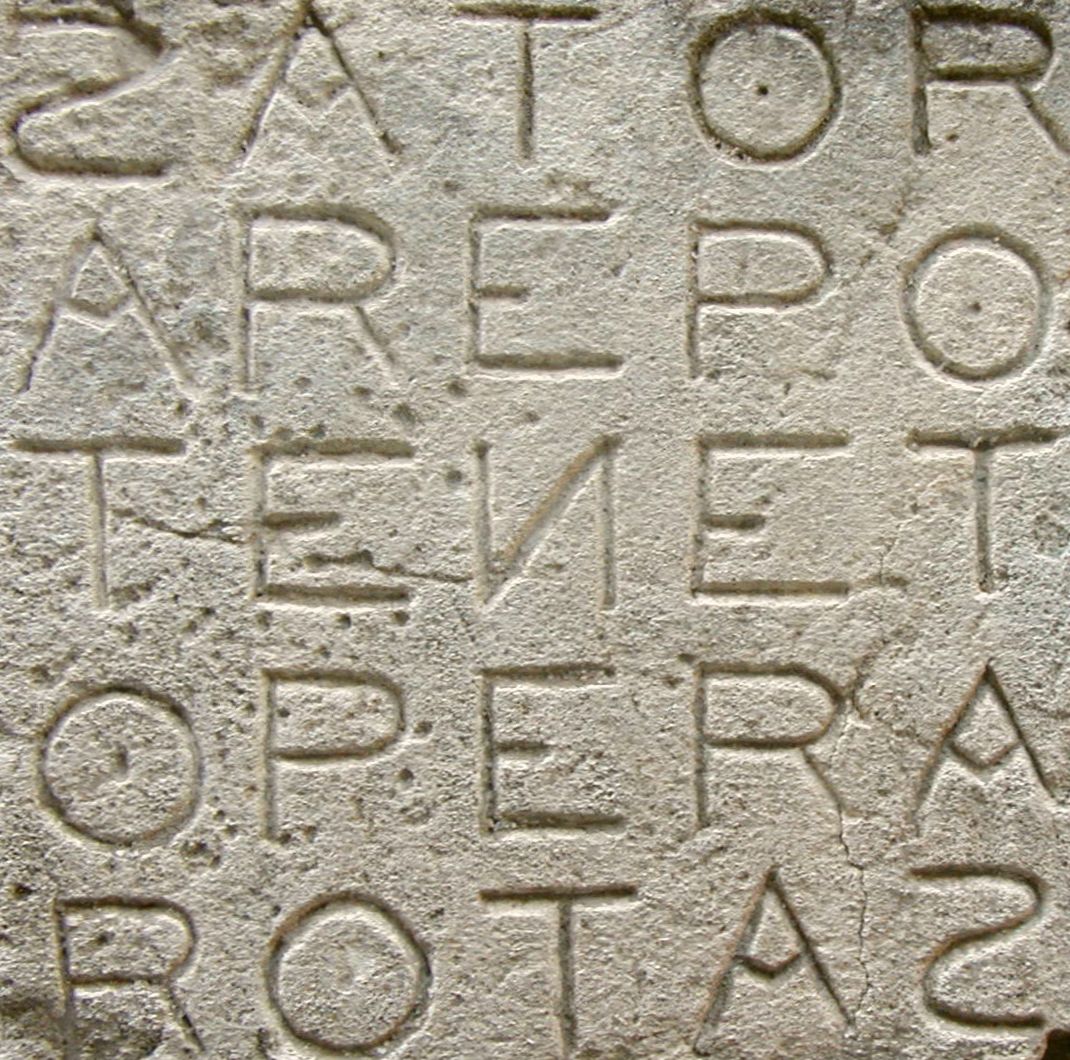
SATOR square at Opède in France
Licensed under the Creative Commons Attribution-Share Alike 3.0 Unported license.
Image available here.

The SATOR square is not only a word square, but also a palindrome.
The oldest complete example of the SATOR square was found in the ruins of Pompeii, carved onto a column of the Palestra Grande. Since this building was destroyed in the earthquake in the year 62 CE, the SATOR square must originate before this date.
What does it actually mean?
Unfortunately, that is not so clear, because Arepo is not a Latin word. One interpretation is that Arepo is a name. In this it would mean something like Arepo the sower guides the wheel with care.
Another interpretation is that the words should not all be read left to right, but alternatly left to right and right to left and that it should be read as two phrases.
→ SATOR
  AREPO ←
→ TENET

  TENET ←
→ OPERA
  ROTAS ←
With this interpretation, the text is Sapor opera tenet - Tenet opera sapro, which loosely translated could mean as you sow, so you shall reap.
Is it a word game?
No.
There is no evidence that Romans ever tried to create word squares as a pastime. The SATOR square appears to be one of a kind.
The SATOR square turns up at many places. It was certainly a curiosity, and may even have been considered to be magical symbol.
Today, we would probably describe it as a meme. The occurrence of the SATOR square in the ancient and medieval world is not unlike when something "goes viral" on the internat. The difference is, that it was carved in stone rather than posted on social media, and the timescale was much much longer.