Word Ladder
Get from the starting word to the target word, changing just one letter at a time.
Wortleiter
Gelangen Sie vom Ausgangswort zum Zielwort, indem Sie jeweils nur einen Buchstaben ändern.
L'échelle de mots
Passez du mot de départ au mot d'arrivée en ne changeant qu'une seule lettre à la fois.
All about chords
Learn all about chords in our comprehensive guide.
The guide is split onto 4 pages:
Welcome to Words and Music Games!
At Words and Music Games we create daily puzzles that are both entertaining and educational.
Test your vocabulary with Word-Ladder, a classic word game first invented by Lewis Carroll, where you transform one word into another by changing one letter at a time. For German speakers we offer Wortleiter, the same addictive challenge in German.
If you prefer music, try Chordle, a daily ear-training game where you listen to a chord and guess its notes in just six attempts.
Whether you love language or music, our games bring you a fresh challenge every day.
Word Ladder starts off with the starting word, the target word, and a blank line in between:
When you enter a new word, a new blank line is added:
The green background indicates a letter that matches the same letter in the target word. When you finish the challenge, all four letters will have a green background.
The challenge is to find a sequence of words from the starting word to the target word, changing just one letter at a time. And of course, all of the words must be real words in the English language.
You can't think of any words. Help is at hand!
After 40 seconds, a small "neighbours" symbol is displayed to the left of the word.
Touch it, or hold your mouse over it, and you get a diagram showing all the neighbouring words.
Of course, you can solve the puzzle without looking at this diagram.
The daily challenge
Every day there is a new word ladder to solve.
The word list
Every word that you enter in Word Ladder has to be a real word. Word Ladder uses a comprehensive list of 4-letter words in the English language.
The basic principle, is that the list should contain all 4-letter words in the English language. In most cases, it is clear whether something is a word or not. For example "book" is a word, but "kvas" is not.
However, there are a lot of cases where it is a matter of judgement, whether a word should be included in the list or not. This includes, for example, foreign words or archaic words.
You can read about our guidelines for which words are included, and which words are not included, on the page
But more than that, you can see the complete word list on our page
Missing words?
If you think a word is missing from the list, let me know!
History of word games
Word games start to develop after two critical preconditions have been met.
- Widespread literacy. Obviously, people who can't read and write do not play word games.
- Cheap printing and paper production, which enabled the production of newpapers and other periodicals.
Word Ladder is an early example of a word game which was published in a periodical.
Word Ladder was invented by Lewis Carroll (the author of Alice's Adventures in Wonderland) and published in the British magazine ‘Vanity Fair’ in 1879. He called the game "Doublets".
Learn more about the history of Word Ladder on the page:
Games published in periodicals are an important category. 34 years after Doublets, in 1913, the first crossword is published in the 'New York World'.
But for the most part, the history of word games mirrors the history of games. Puzzles in newspapers, board games, radio games, TV games, computer games. In each new category, somebody will probably invent a word game.
Read more about the history of word games on the page:
Even before the age of mass literacy, ancient scribes seem to have played with words. Two curiosities have survived from the ancient world:
- palindromes
- word squares and specifically, the SATOR square
Read more about these on the page:
The idea behind Chordle is that you listen to a chord and then try to guess what the chord is.
This is what the game looks like in the 3-Note piano version.
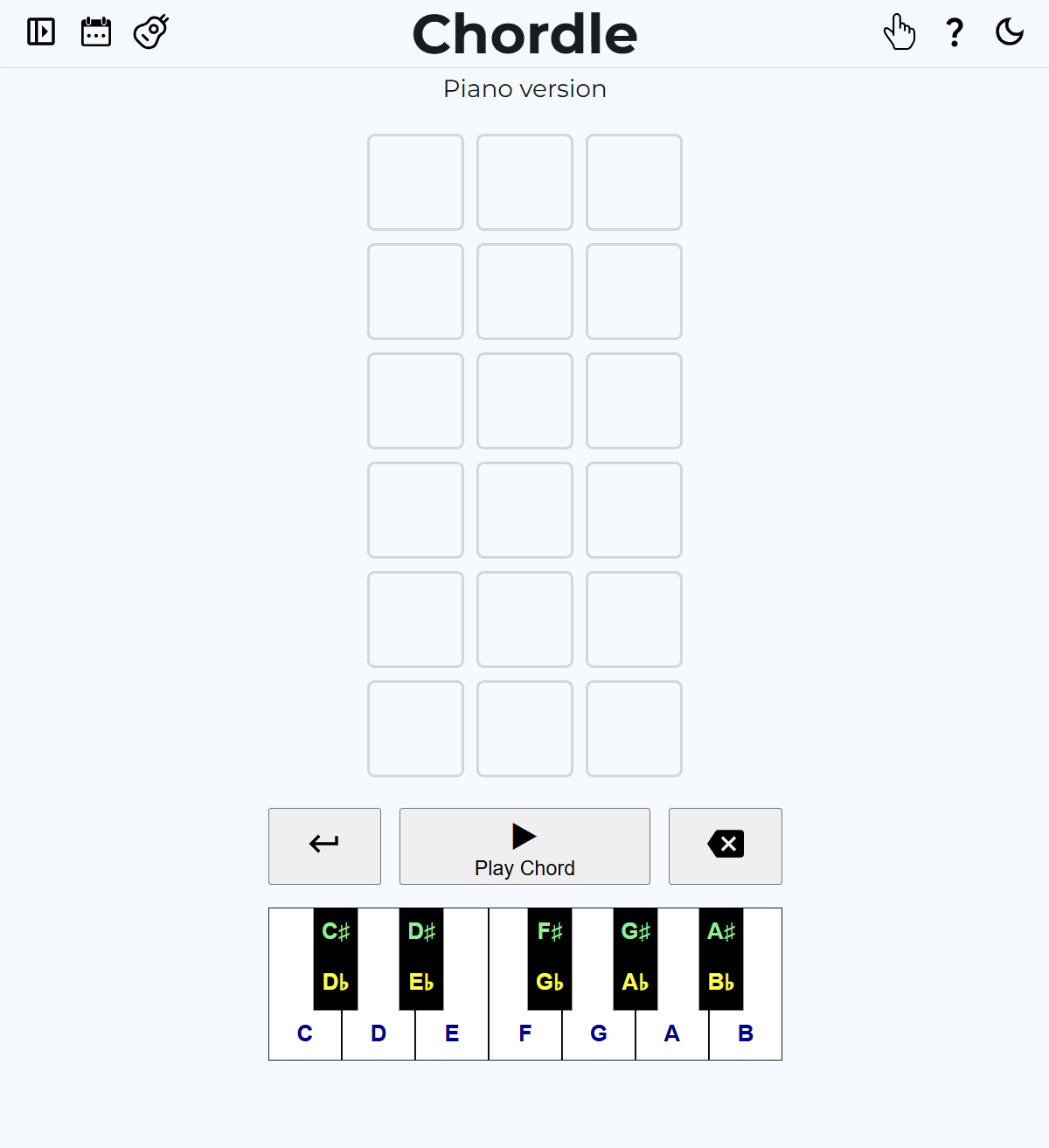
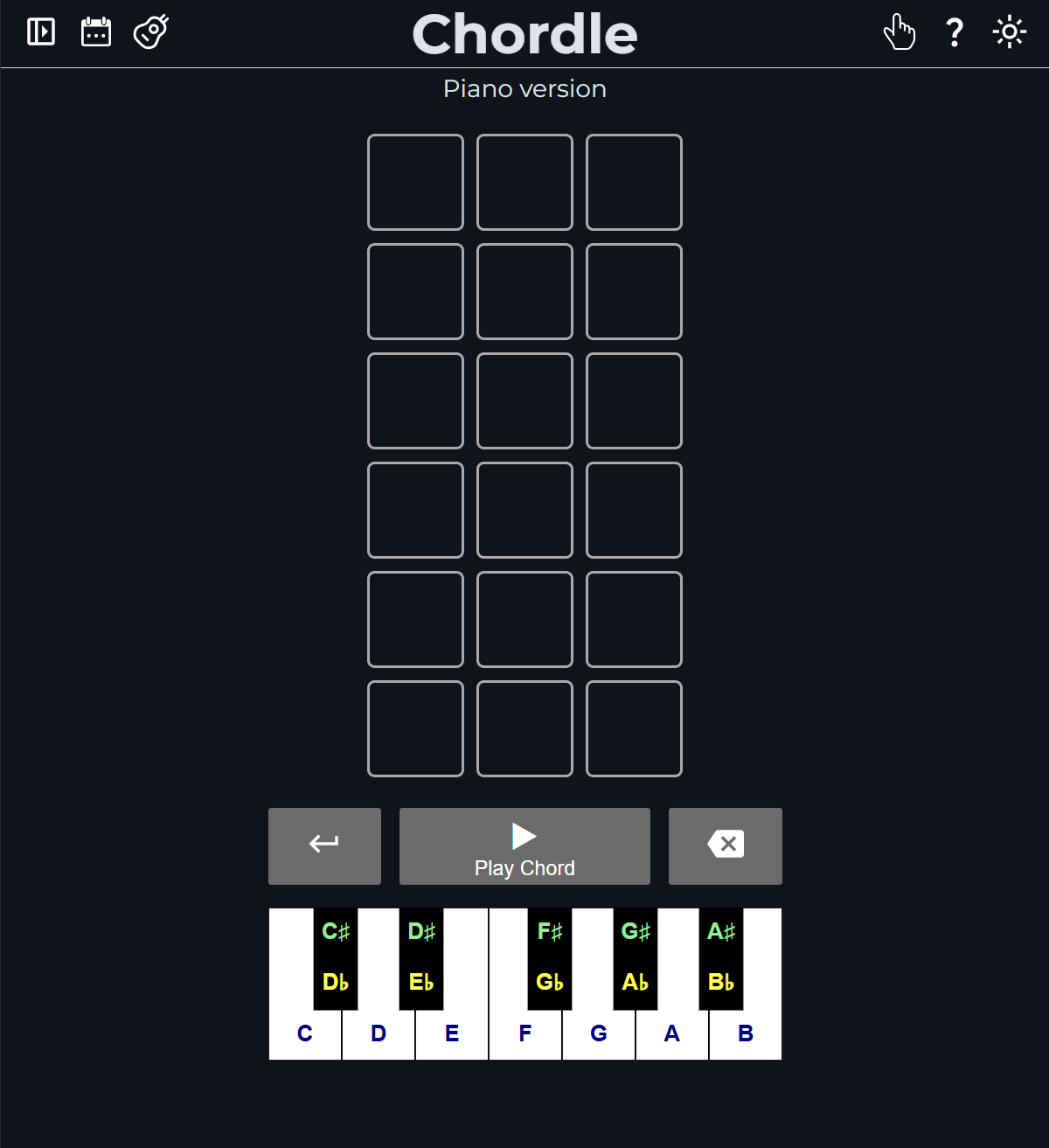
Using the "Play Chord" button ▶ you can listen to the chord. Then you can enter your first guess using the piano keyboard, and submit it using the enter key ⏎.
This is what it might look like after making two guesses.
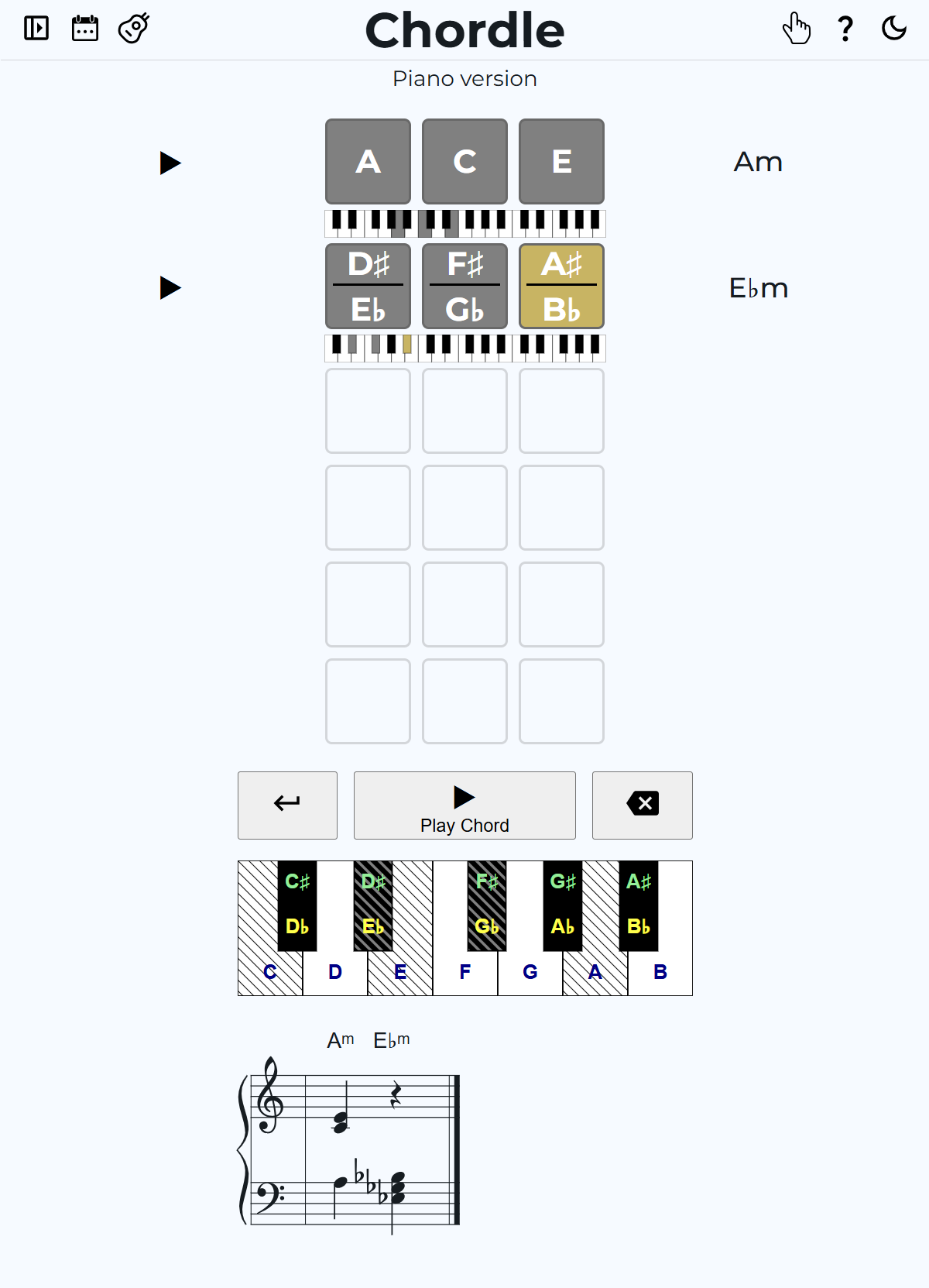
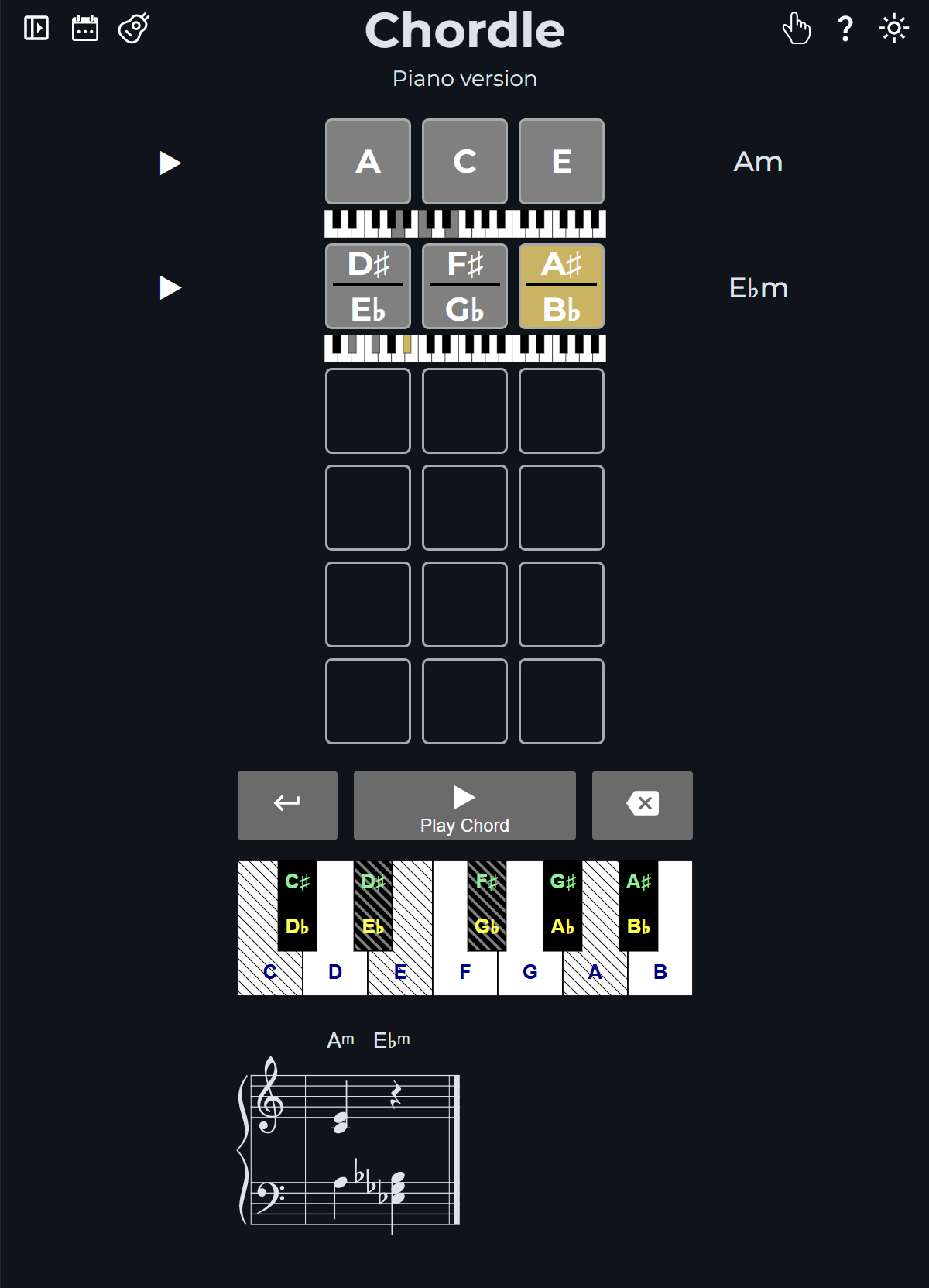
After entering a chord, Chordle does a number of things:
- it sets the background colour of the notes to indicate
- green - right note, right position
- yellow - right note, wrong position
- grey - wrong note
- it determines what the chord is, and shows it to the right of the notes
- it shows a play button ▶ to the left of the notes
- it shows a pattern on the piano keys for the wrong note
- it shows a the chord on a piano keyboard below the notes
- it shows the chords in musical notation at the bottom of the screen
Using the play button ▶ next to the chord, you can listen to your guess, and compare it to the original chord.
Note:
You cannot listen to your chord until you have sumitted it using the enter key ⏎.That would be too easy!
In the guitar version, it looks a bit different:
- instead of a piano keyboard, you use a guitar fretboard to enter notes
- after entering a chord, it shows the notes on a fretboard on the right hand side
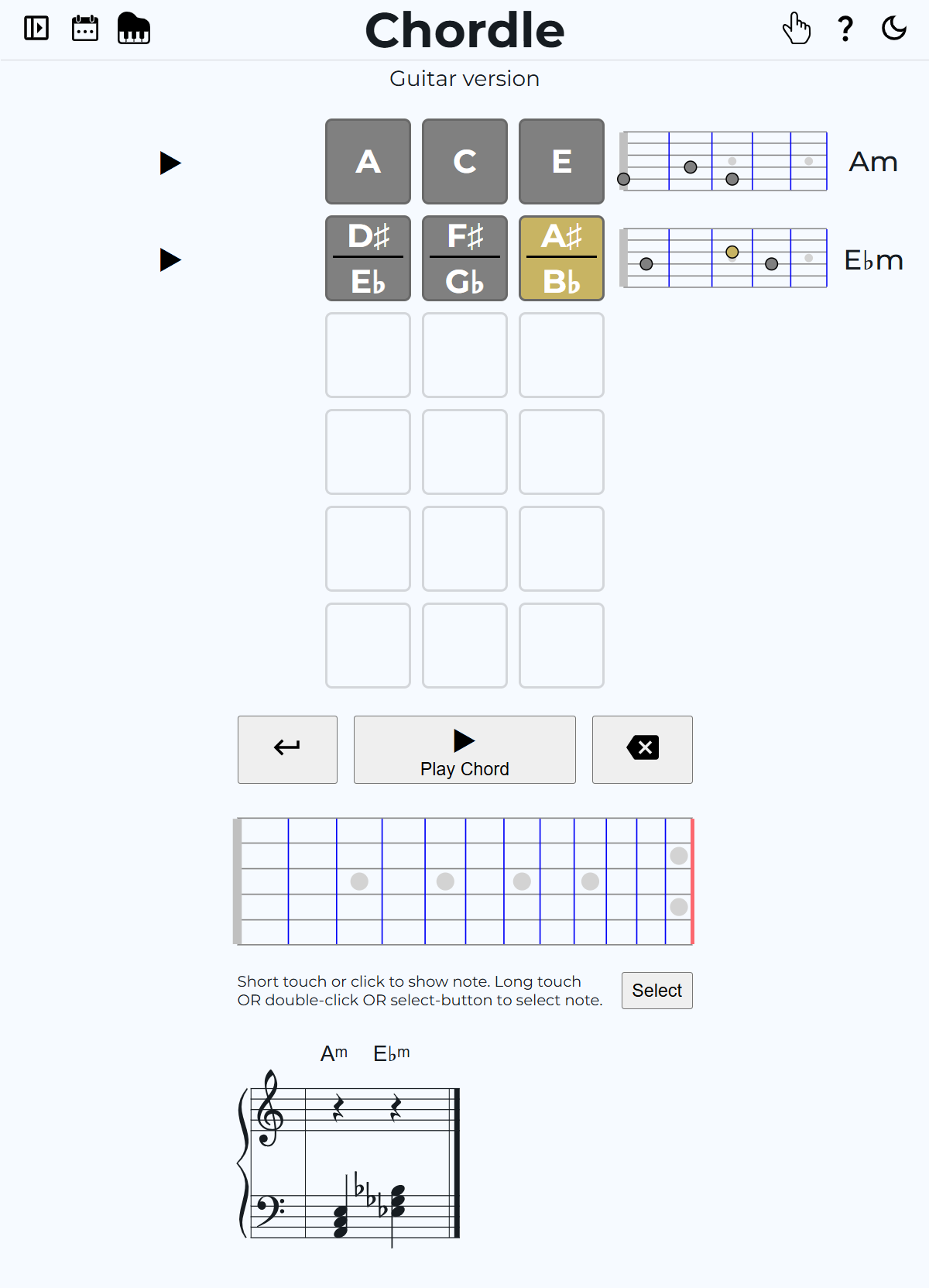
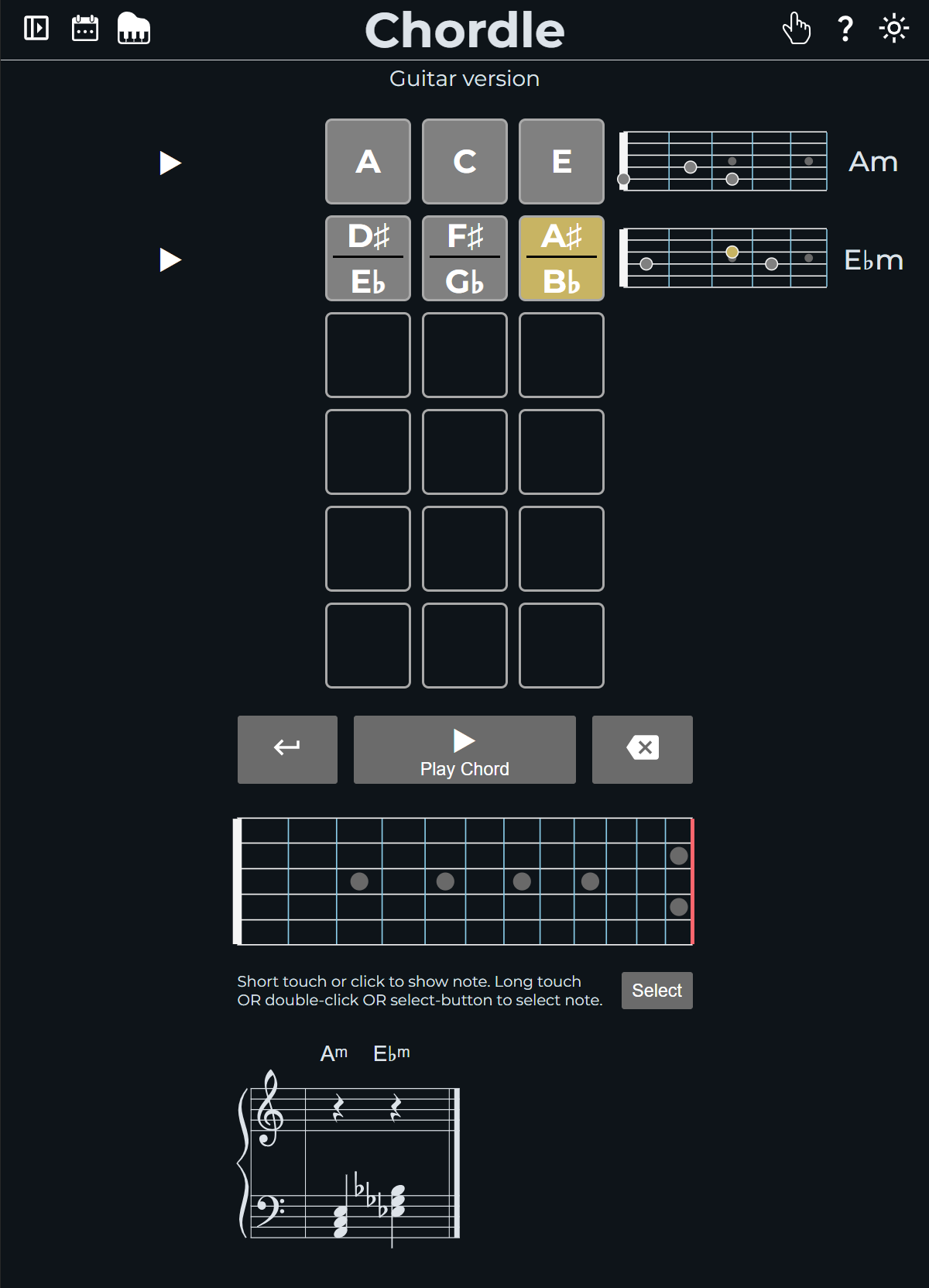
You can switch between these two versions using the guitar symbol or the piano symbol on the toolbar.
By the way, when you play the chord in the piano version, it sounds like a piano. When you play the chord in the guitar version, it sounds like a guitar.
Continuing the game, when I listened to the two guesses and the original chord, I could hear that:
- the first note was too high in the first guess
- the first note was too low in the second guess
In fact it sounded about one tone lower than the first note in the first guess (A) so it might be G.
We know that B♭ is in the chord, because it had a yellow background as the third note. If the first note is between E♭ and A, then it cannot be B♭, so B♭ must be the second note.
The chord sounded like a minor triad, so I decided to try D as the third note.
And that was correct!
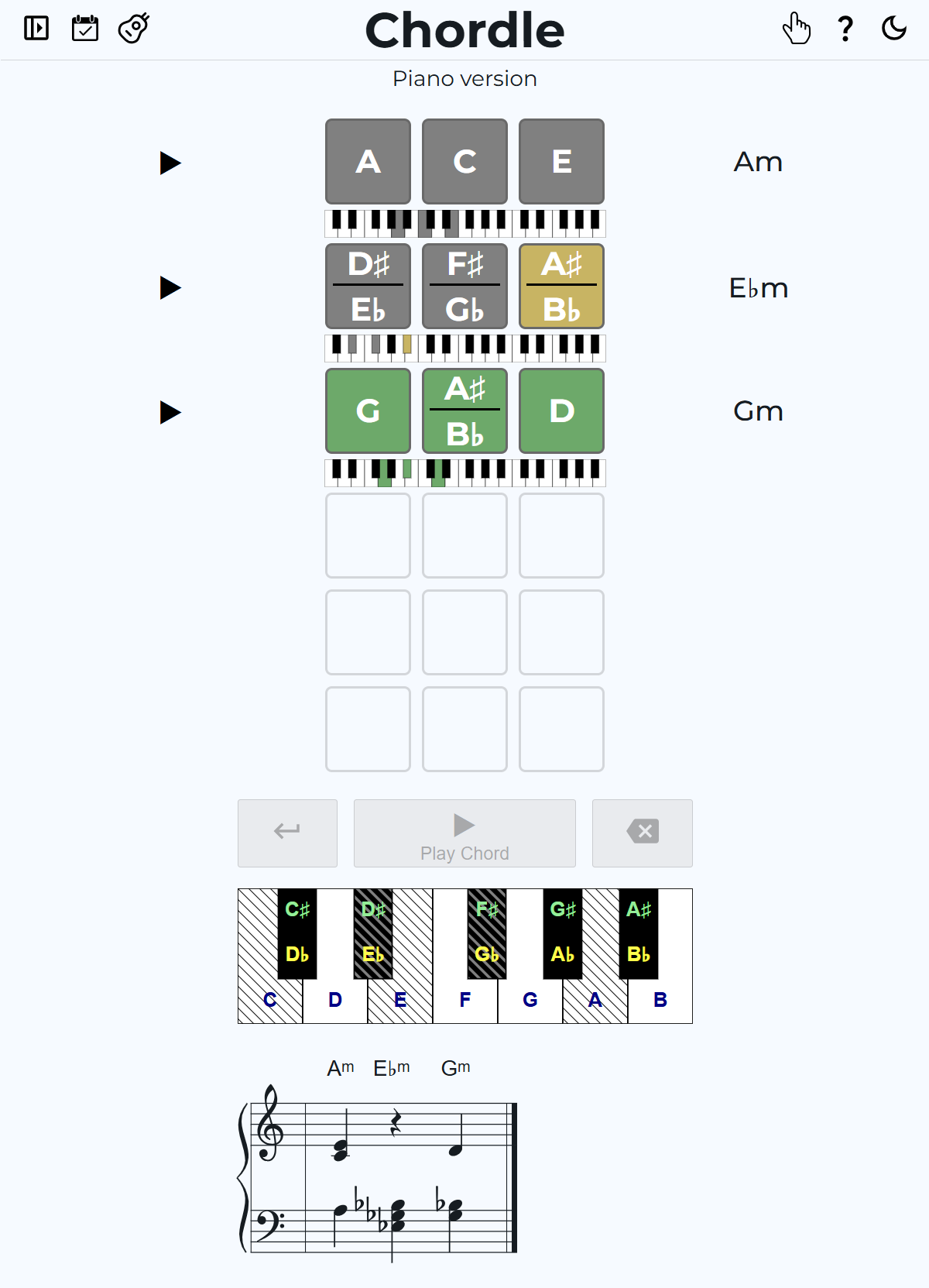
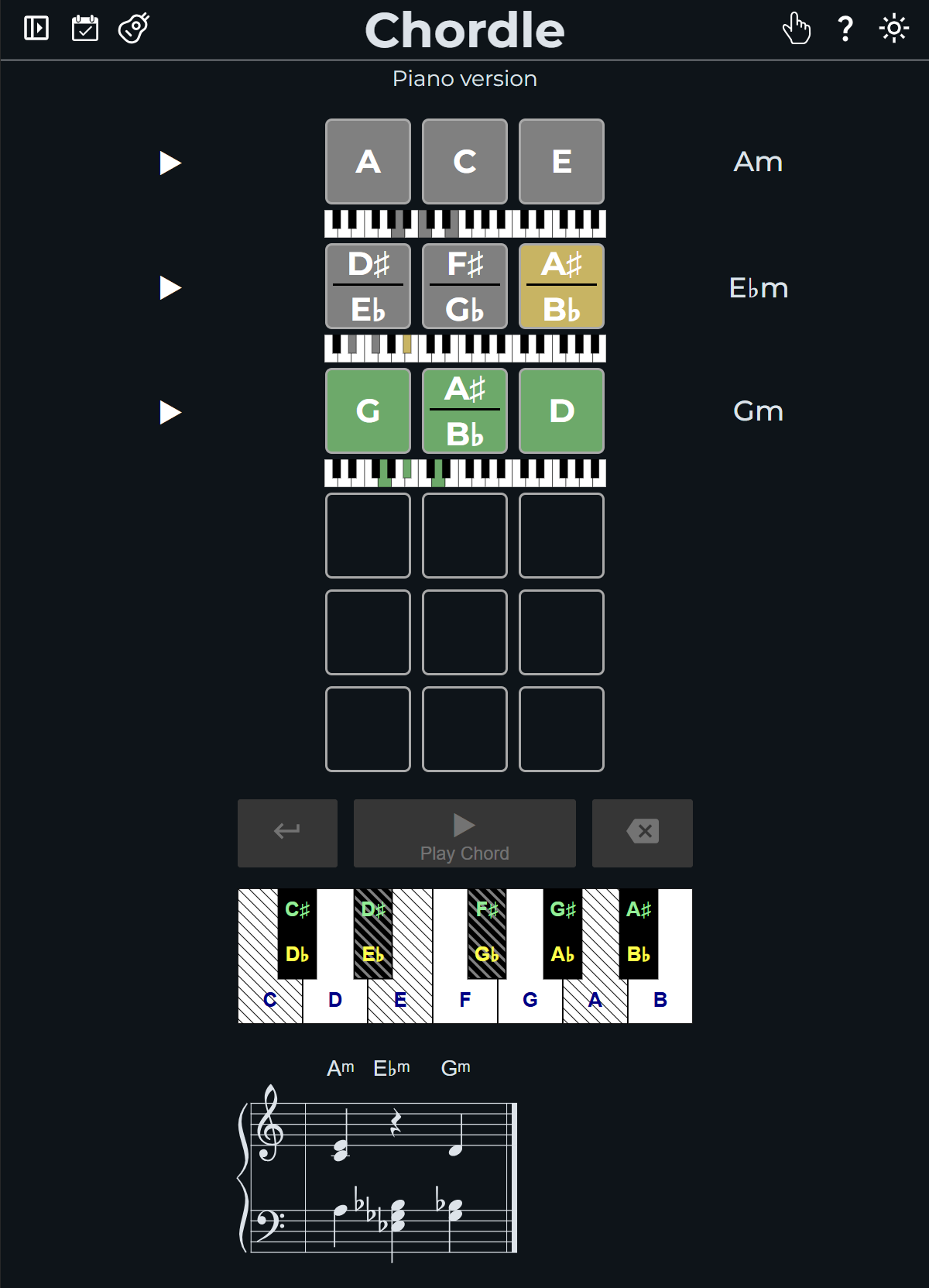
Three different versions
The very first version of Chordle had 5 notes, making it very like the popular game Wordle. For most people, that is too hard, which is why we introduced versions with 4 notes and 3 notes.
The three versions are almost identical, but have one key difference.
- In the 4-note and 5 note versions, the first note is always the root note
- In the 3 note version, the root note may be at any position
The daily challenge
Every day there is a new chordle to solve.
Start the Daily Game:
The chords in Chordle
Chordle has a dictionary of chords and voicings which are allowed in the game.
This dictionary contains chords with 3, 4 and 5 notes, which are listed on the following pages:
Obviously you can use the 3, 4 and 5-note chords in the 3, 4 and 5-note games respectively.
You can also use:
- the 3-note chords in the 4-note and the 5-note game
- the 4-note chords in the 5-note game
This works by using one note twice, or even three times.
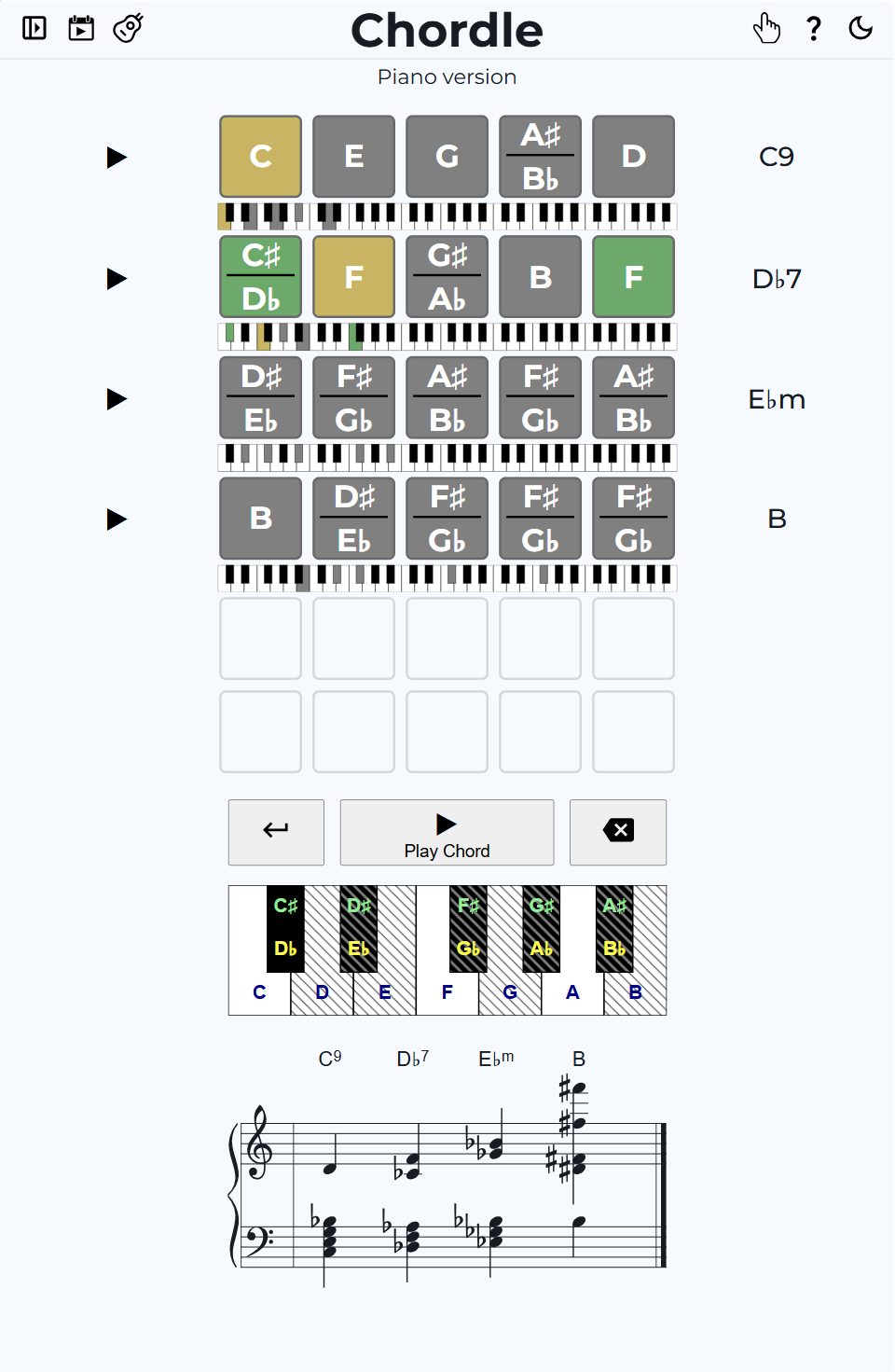
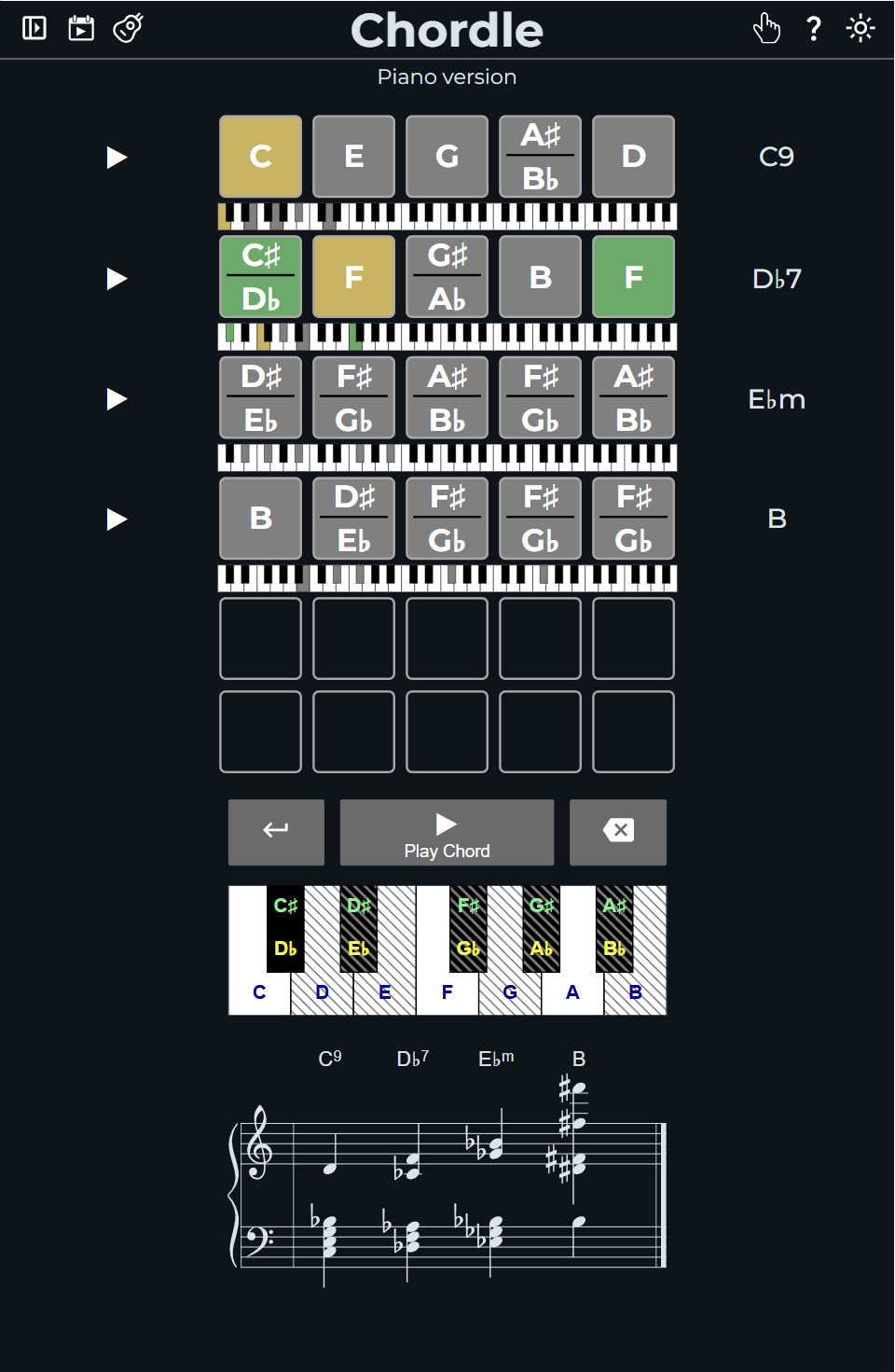
Look at the following example:
- The first chord has 5 different notes C-E-G-B♭-D.
- The second chord has only 4 different notes D♭-F-A♭-B-F.
F appears twice. - The third chord has only 3 different notes E♭-G♭-B♭-G♭-B♭.
Both G♭ and B♭ appear twice. - The fourth chord also has only 3 different notes B-E♭-G♭-G♭-G♭.
In this case G♭ appears three times.
There is an overview of the chords in the chordle on the chords page, but to really understand the chords, you need to read our guide to All about chords.
All about chords
Why are chords important?
Music is built using many elements, but the three most essential are rhythm, melody and harmony.
Rhythm give music the pulse that drives it forwards. Rhythm is so essential that it is hard to imagine any music without it.
Every song has a melody, which is the sequence of individual notes sung by the singer. Instrumental music will usually have something that you can recognise as a tune.
A melody is always a sequece of single notes - or pauses - one after another. In music theory that would be called monophonic. Music without a melody sounds like a backing track, rather than music in its own right.
Wheras the melody is a sequence of notes played one after another, harmony is formed by notes played at the same time. Harmony enriches the melody, giving it emotion and depth. Harmony can make the melody sound happy or sad. Harmony can build tension, and resolve the tension.
A solo instrument or singer without accompaniment does not - on the face of it - have any harmony. But as the melody unfolds, the relationships between the notes suggest some underlying harmony which the listener can feel, even if it is not played by any other instruments.
Chords are the building blocks of harmony
A chord is by definition a set of notes played together. This means that each step in a harmony is a chord.
The harmonic sequence, or simply the chord progression, and its timing, build the harmony of a piece of music. More than just the individual chords, the harmonic sequence defines how a piece of music feels.
Why are chords interesting?
Chords are interesting for all musicians, but in particular for guitarists and pianists or keyboard players.
The guitar, the piano and electronic keyboards are polyphonic instruments, which means that they can play more than one note at once. This makes them ideally suited to playing chords. These are also very common instruments.
A lot of music - in particular classical music - is written out in musical notation in great detail, but that is not the whole story. However a lot of musicians play from a minimalisic song notation.
For pop and rock music, there are countless websites which give you the lyrics of a song, along with the chords, written above the words. If you want to sing the song, this assumes that you know the melody. This is not unrealistic, because many people find a melody easy to remember.
For jazz players, it is very common to use a lead sheet. This is usually a single page, with the melody and with chords above the music.
A particularly well know source is the so called Real Book, which - although illegal - became the standard work for many jazz musicians, including jazz pianists.
The common requirement, is that you understand and know how to play the chords.
What is so mysterious about chords?
Millions of young people know a few chords on a guitar. If you use a chord dictionary - as a book or online - you can learn more chords, and learn to play more songs.
The thing is, that learning the shape of a chord or a guitar doesn't teach you much about the how the chord is constructed. It's easy to learn the shape of a G chord, without any understanding of which notes you are playing, and why those notes form a G chord and not a C chord.
There are lots of different chords. If you look at chord dictionary, you will find a selection of different chords, like G, G7, Gm, Gm7, GΔ7, Gsus4, G6, Gdim, ...
Now if you want to play a song, which contains a Gdim chord, you can learn the shape of the chord from a chord dictionary, but that doesn't give you any understanding of what the chord is, and what notes it contains.
Going a level further, here is a screenshot of the chord menu in the App iRealPro. (iRealPro is an App to generate a backing track from a chord progression, to practice your instrument.)
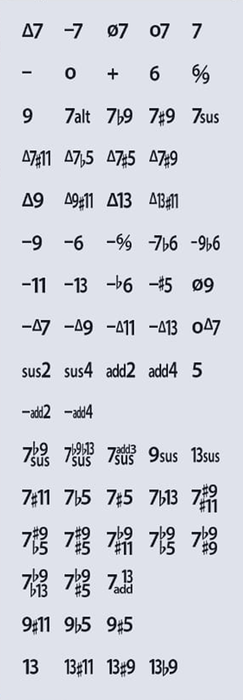
iRealPro is an App to generate a backing track from a chord progression. It is used by instrumentalists to practice with.
This screenshot gives a feel for the number of different chords that can be used, particularly in jazz.
What is our approach
The screenshot from iRealPro is, at first sight, overwhelming. To get to grips with range of possible chords, we break it down in four categories:
- triad
- seventh chords
- added note chords
- extended chords and altered chords
This builds a logical sequence from the simplest to the most complex chords.
Along the way, we introduce a lot of terminology, like interval, octave, chord factor, scale, etc. We take very little prior knowledge for granted.
Illustrating chords on the piano and the guitar
Simply explaining the notes in a chord, for example that a C-major-triad contains the notes C-E-G, does not convey much understanding.
To explain chords, we need some way to illustrate them in a visual manner. Three ways spring to mind:
- using musical notation
- using a piano keyboard
- using a guitar fretboard
We do not use musical notation at all. Musical notation can be very precise, but for a lot of people is difficult to read. In particular, chords written in musical notation can be difficult to read.
Instead of using musical notation, we willustrate chords using the piano keyboard and on a guitar fretboard.
On the piano keyboard
On the piano keyboard, we mostly illustrate chords with the root note C.
For example, we might illustrate C-dominant-7 chord as
Both the numbers and the colours indicate the so called "chord factor", which is explained in the articles. The specific colours are random, but the same colours are used consistently in all diagrams.
On the guitar fretboard
On the guitar fretboard, we take a slightly different approach, based on two ideas:
- show movable chords
- show a conceptual shape and a playable shape
The simplest kind of guitar chord are so called "open chords". These are played at the base of the fretboard and some of the strings left open.
In contrast, movable chords do not use any open strings. (If you are not holding a string down, then you must not play it.) The great thing about movable chords, is that you can move them up and down the fretboard to play the same kind of chord, but with a different root note.
When we describe a chord, we show the notes in certain order, starting with the so called root note and working upwards. When you play a chord, you usually keep the root at the bottom, but it's ok to mix up the order of the notes. This is explained in the articles.
Starting with 7th chords, we show chords on the guitar in a conceptual shape, with the notes in ascending order. For example, a B-dominant-7 chord would look like this:
As with the piano keyboard, the numbers and the colours indicate the so called "chord factor", which is explained in the articles.
This diagram gives a good illustration of the notes in the chord, but would be difficult to play, because the notes are spread so far apart. For that reason we show a second playable version of the chord, for example:
In this version, the numbers and the colours still indicate the "chord factor", but you can see that they are now played in a different order.
For the guitar, we go one step further and show the shape with the root note on string 6, 5 or 4.
For example an E7 chord, with the root note on string 5
and an A7 chord, with the root note on string 4
Because these are movable chords, you can of course move them to, for example:
G7
F7
E7
In the diagrams, we always place the root note on fret 7. This is just for practical purposes, because it gives us enough space to down the fretboard (when we show the notes in ascending order).
The articles
The guide is broken down into four articles:
This article introduces the basic ideas about chords and explains the basic terms chord, interval, octave, root note, inversion and voicing.
It introduces chords with three notes known as triads. There are 4 kinds of triad, built with a technique called stacking thirds. The triads are described in detail, and illustrated on the piano and the guitar.
Finally, it describes the suspended-4th chord, which is another chord with 3 notes, but not technically a triad.
This article introduces more terms, like scale and key and starts to explain chord symbols.
It introduces 7th chords, which are chords with 4 notes which - like triads - can be built with the technique of stacking thirds.
Finally, it introduces some less common 7th chords, which don't fit technically fit the scheme of stacking thirds.
This article introduces added note chords, which are basically triads plus another note, but NOT the 7th.
It briefly introduces extended chords, to illustrate the differnce between extended chords and added note chords.
Extended chords take the idea of stacking thirds to the extreme, and can theoretically include up to 7 notes.
In terms of chord factor (which we introduce in the first article), these can be 1 (root), 3, 5, 7, 9, 11 and 13. Of these, the chord factors 1, 3 and 7 are always included, but the others are optional.
Altered chords take this one stage further, by moving any of the optional notes up or down one semitone.
Wortleiter is the German language version of Word Ladder.
Wortleiter beginnt mit dem Ausgangswort, dem Zielwort und einer Leerzeile dazwischen:
Wenn Sie ein neues Wort eingeben, wird eine neue Leerzeile hinzugefügt:
Der grüne Hintergrund zeigt einen Buchstaben an, der mit dem gleichen Buchstaben im Zielwort übereinstimmt. Wenn Sie das Rätsel gelöst haben, sind alle vier Buchstaben grün hinterlegt.
Die Herausforderung besteht darin, eine Wortfolge vom Ausgangswort zum Zielwort zu finden, wobei jeweils nur ein Buchstabe geändert werden darf. Und natürlich müssen alle Wörter echte Wörter der deutschen Sprache sein.
Ihnen fallen keine Wörter ein? Kein Problem!
Nach 40 Sekunden wird links neben dem Wort ein kleines „Nachbarsymbol“ angezeigt.
Wenn Sie darauf tippen oder mit der Maus darüberfahren, wird ein Diagramm mit allen benachbarten Wörtern angezeigt.
Natürlich können Sie das Rätsel auch lösen, ohne sich dieses Diagramm anzusehen.
Das tägliche Rätsel
Jeden Tag gibt es eine neue Wortleiter zu lösen.
Die Wortliste
Jedes Wort, das Sie in Wortleiter eingeben, muss ein echtes Wort sein. Wortleiter verwendet eine umfassende Liste von 4-Buchstaben-Wörtern der deutschen Sprache.
Das Grundprinzip dabei ist, dass die Liste alle 4-Buchstaben-Wörter der Sprache enthalten soll. In den meisten Fällen ist klar, ob etwas ein Wort ist oder nicht. Zum Beispiel ist „Buch” ein Wort, „gobd” hingegen nicht.
Es gibt jedoch viele Fälle, in denen es eine Ermessensfrage ist, ob ein Wort in die Liste aufgenommen werden soll oder nicht. Dazu gehören beispielsweise Fremdwörter oder archaische Wörter.
Auf der folgenden Seite können Sie unsere Richtlinien dazu lesen, welche Wörter in die Liste aufgenommen werden und welche nicht.
Darüber hinaus können Sie die vollständige Wortliste auf der folgenden Seite einsehen.
Fehlende Wörter?
Wenn Sie glauben, dass ein Wort in der Liste fehlt, lassen Sie es mich wissen!
L'échelle de mots is the French language version of Word Ladder.
Tout d'abord, vous voyez le mot de départ, le mot d'arrivée et une ligne vide entre les deux :
Lorsque vous saisissez un nouveau mot, une nouvelle ligne vide est ajoutée :
Le fond vert indique une lettre qui correspond à la même lettre dans le mot d'arrivée. Lorsque vous aurez terminé le défi, les quatre lettres auront toutes un fond vert.
À chaque étape, vous ne pouvez modifier qu'une seule lettre du mot. En partant de « RAGE », nous avons remplacé la première lettre « R » par « P » pour obtenir le mot « PAGE ».
Vous ne trouvez aucun mot ? Pas de problème !
Au bout de 40 secondes, un petit symbole « voisins » s'affiche à gauche du mot.
Touchez-le ou passez votre souris dessus pour afficher un schéma présentant tous les mots voisins.
Bien sûr, vous pouvez résoudre le casse-tête sans regarder ce schéma.
Le défi quotidien
Chaque jour, un nouveau jeu vous attend.
La liste de mots
Chaque mot que vous saisissez dans Word Ladder doit être un vrai mot. Word Ladder utilise une liste exhaustive de mots de quatre lettres de la langue anglaise.
Le principe de base est que la liste doit contenir tous les mots de quatre lettres de la langue anglaise. Dans la plupart des cas, il est facile de déterminer si un terme est un mot ou non. Par exemple, « doit » est un mot, mais « kvas » ne l’est pas.
Cependant, il existe de nombreux cas où la décision d’inclure ou non un mot dans la liste relève d’un jugement subjectif. C’est notamment le cas des mots étrangers ou des mots archaïques.
Vous pouvez consulter nos critères de sélection, qui précisent quels mots sont inclus et lesquels ne le sont pas, sur la page
Vous pouvez consulter la liste complète des mots sur notre page
Mais surtout, vous pouvez consulter la liste complète des mots sur notre page
Il manque des mots ?
Si vous pensez qu'il manque un mot dans la liste, faites-le-moi savoir !