Welcome to Words and Music Games!
At Words and Music Games we create daily puzzles that are both entertaining and educational.
Test your vocabulary with Word-Ladder, a classic word game first invented by Lewis Carroll, where you transform one word into another by changing one letter at a time. For German speakers we offer Wortleiter, the same addictive challenge in German.
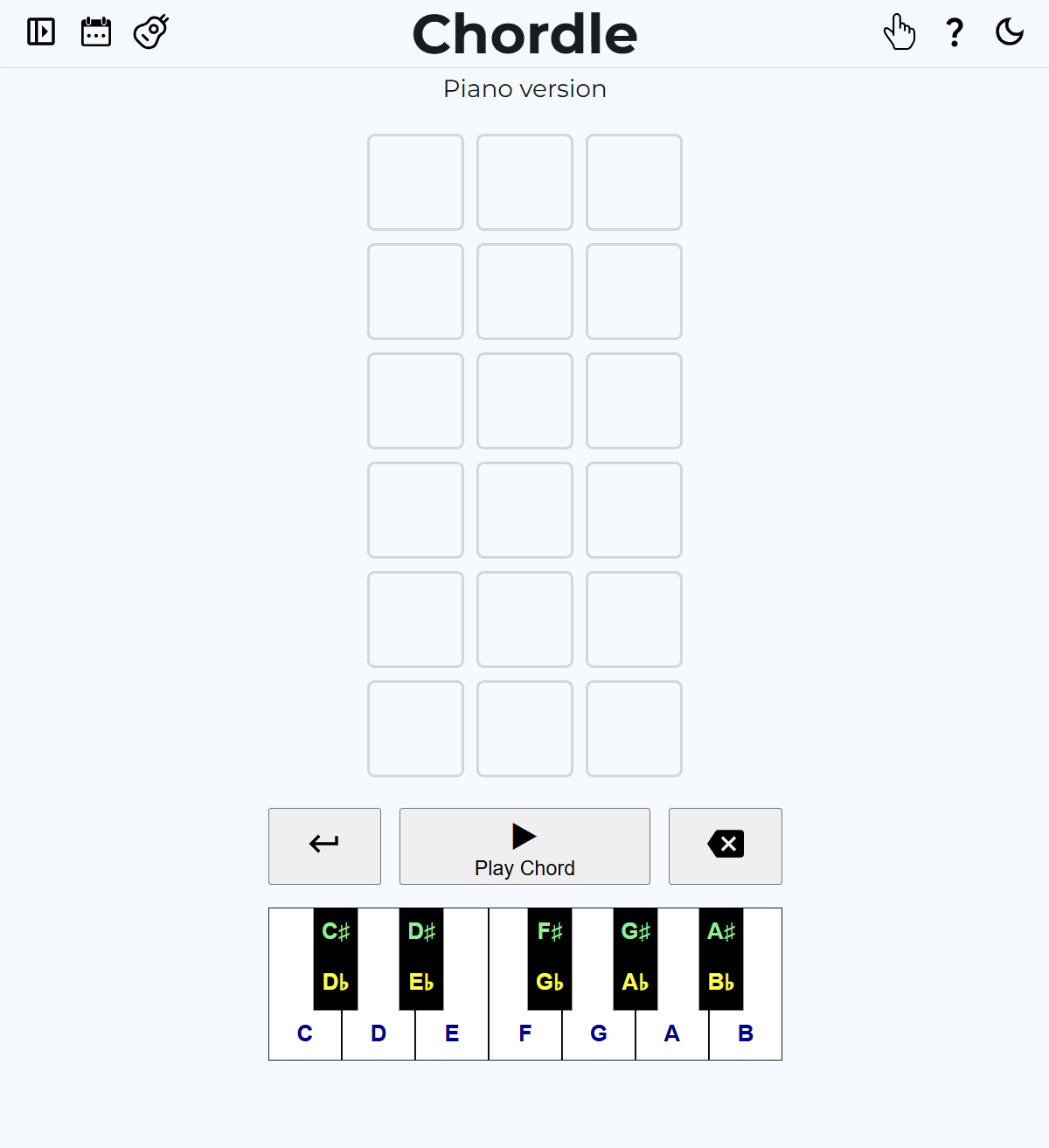
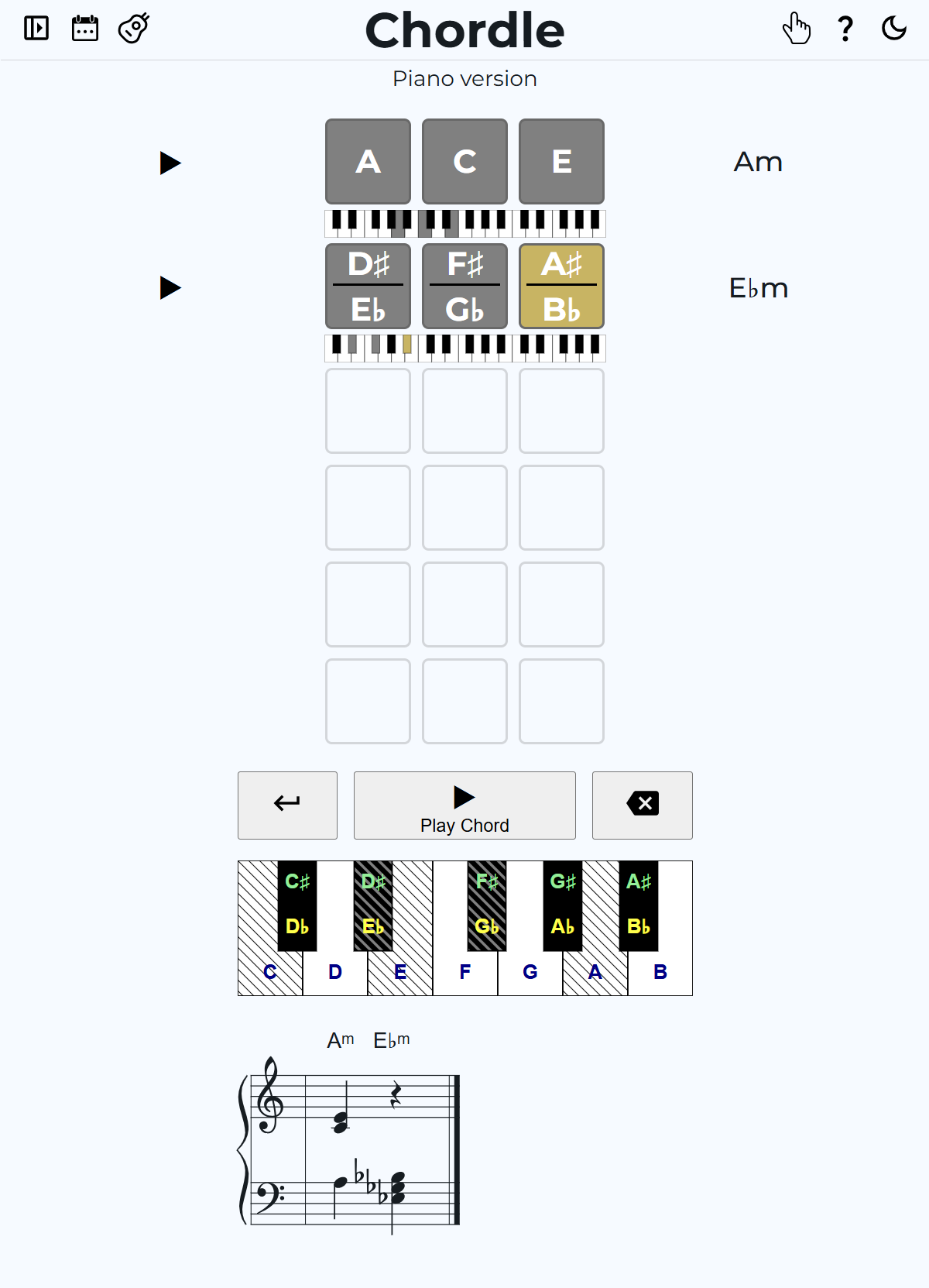
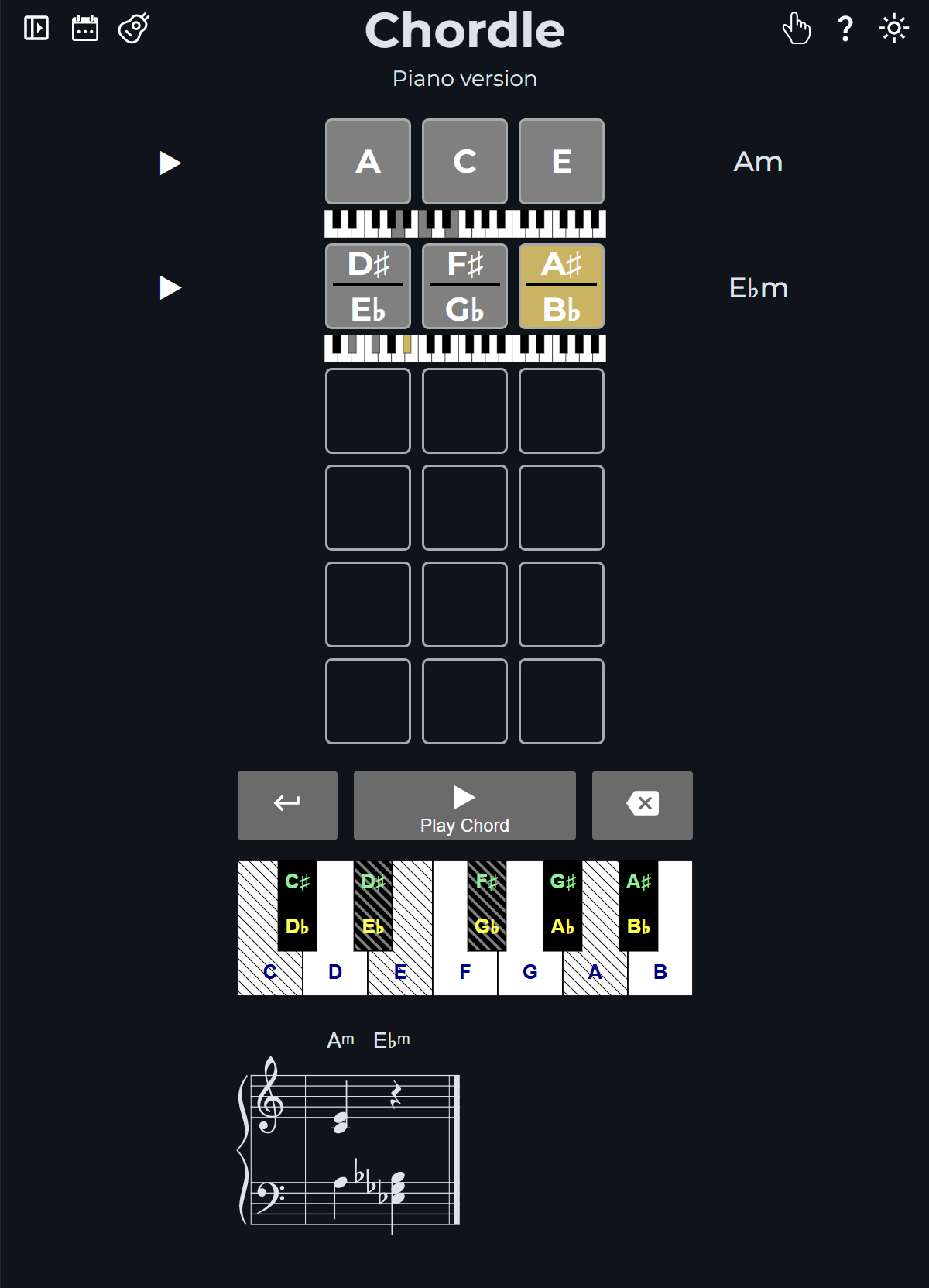
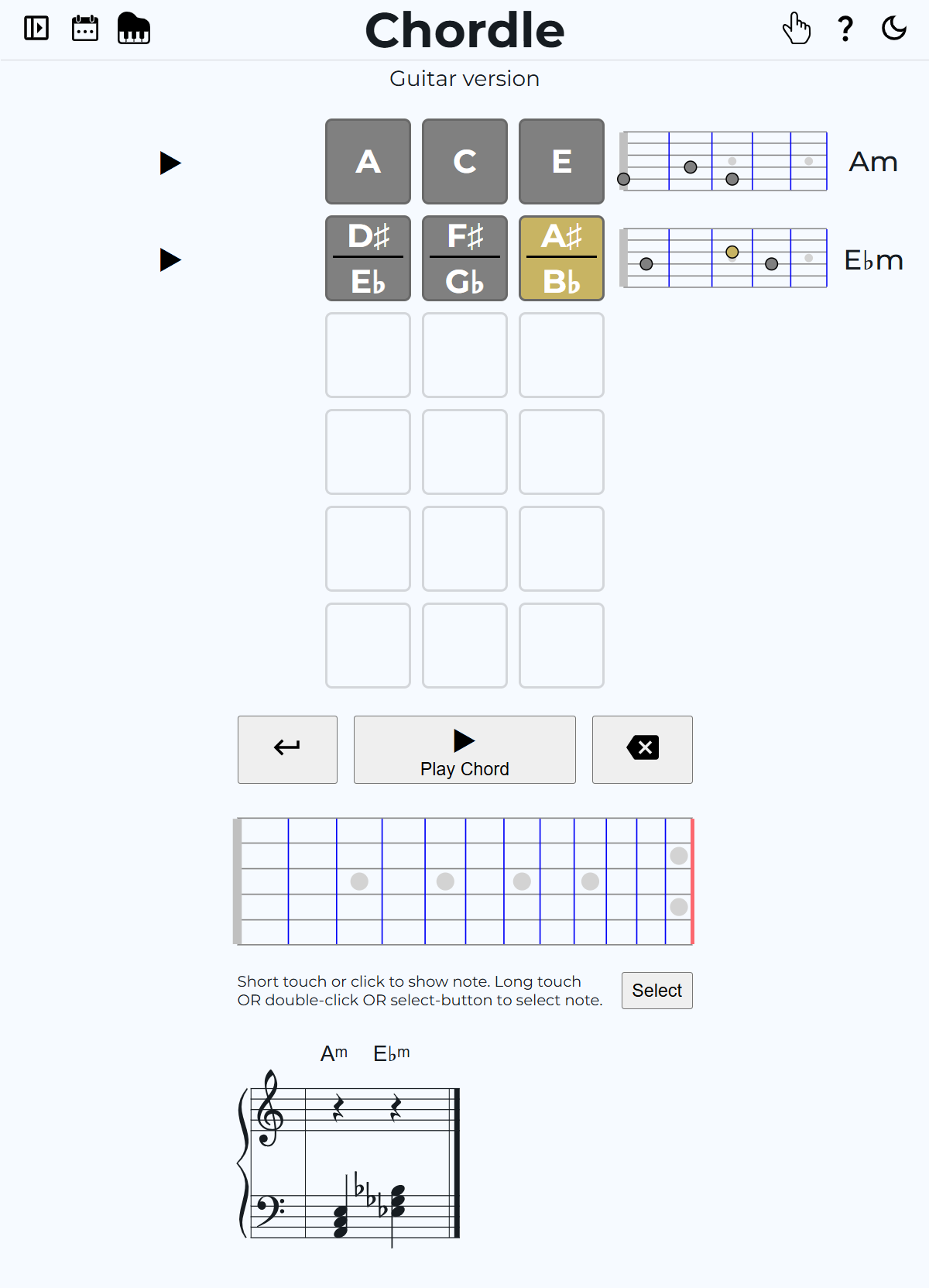
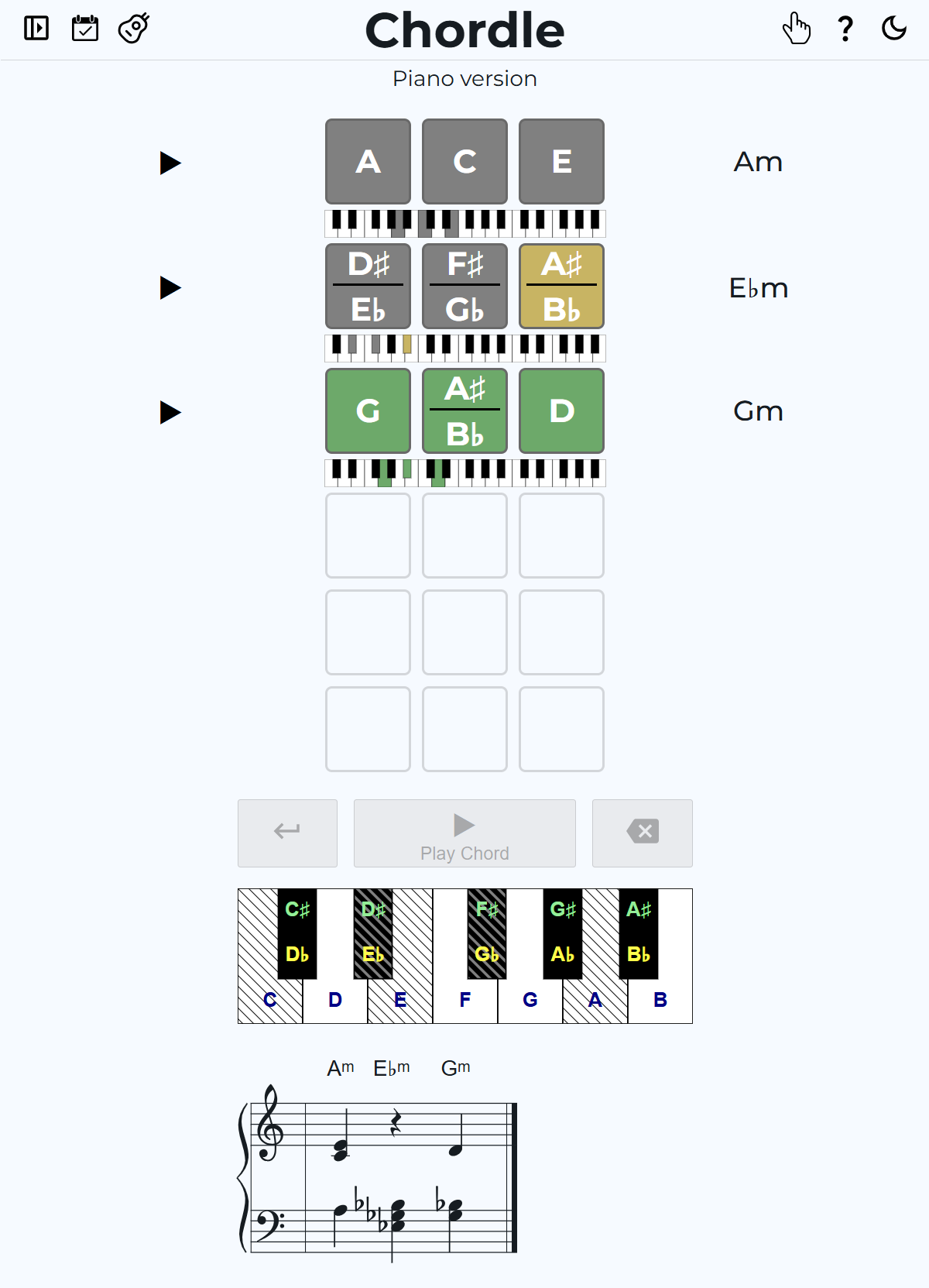
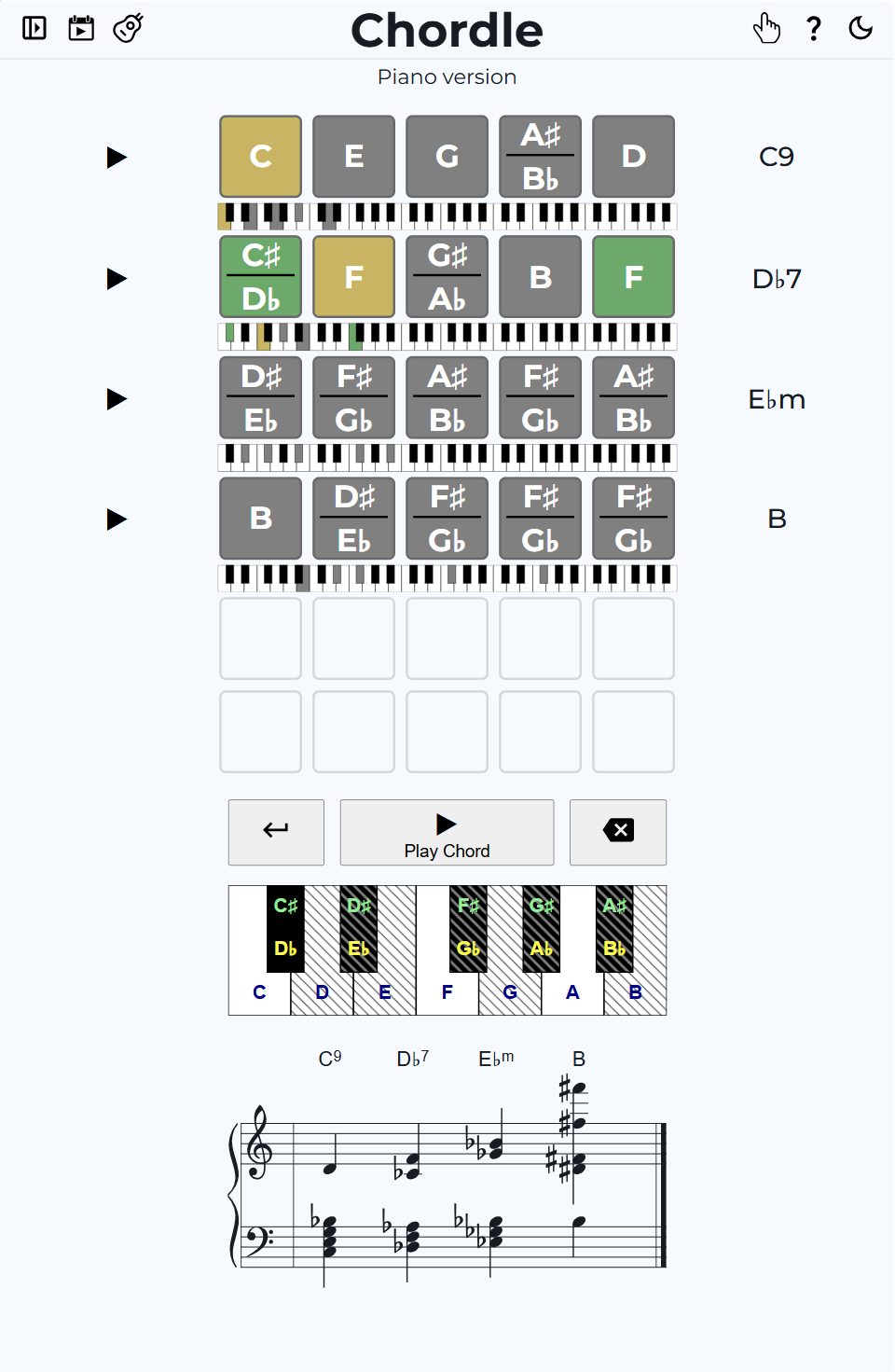
If you prefer music, try Chordle, a daily ear-training game where you listen to a chord and guess its notes in just six attempts.
Whether you love language or music, our games bring you a fresh challenge every day.
Start the Daily Game:
Convert the start word
to the end word,
one letter at a time.
Das tägliche Spiel starten:
Verwandeln Sie das Anfangswort in das Endwort, Buchstabe für Buchstabe.
History of Word Games
Word Ladder is by no means a new game. It was invented in 1879 and has a place in the evolution of word games.
Let's take a look at the history of word games, and how they fit into the history of games. After that, I will go into more details about some of the games.
Literacy and printing
Let's start with two obvious facts.
- Word games only work if you can read or write
- Games in newspapers only work if there are newspapers
Literacy is becoming widespread in Europe during the 18th century, and takes off with mandatory schooling in the 19th century. Before that, there were no word games.
The first newspapers emerged in the 17th century, followed by the first magazines in the 18th century. Magazines published serialized fiction, for example the novels of Charles Dickens, in the first half of the 19th century.
At that time, printing was still quite expensive, but that was about to change with development in both printing and in the production of paper.
This was the beginning of an era of cheap mass printing starting, and the emergence of new mass circulation family magazines. That sets the stage for the development of the most common word games.
Games
Before going on to look specifically at word games, let's look at the development of games in general.
Up until about the 18th century and the so called age of enlightenment, there were more or less three kinds of game, which have a very long history. These are card games, dice games and board games like chess of backgammon. These games were played in taverns and in other public spaces, but not so much in private dwellings. Games were played for entertainment and companionship, but an important element was gambling.
After the enlightenment, in the 18th and 19th centuries, two new categories develop in parallel:
- educational games
- parlour games
Educational games are a way to test childrens knowledge, to motivate them, and to reward the best performers. A good example might be a test for mental arithmetic. Educational games are principally interesting because of one game, the spelling bee, which is older than most other word games, and continues to be popular in the United States.
Parlour games on the other hand, are basis for more or less all other word games.
Parlour games
Parlour games sound old fashioned, not least because the word parlour sounds old fashioned.
The parlour is the equivalent of a modern day living room, but in the 18th and 19th centuries, this was a room which only the middle and upper classes would have had.
As the name suggests, parlour games are games which would be played in the parlour. These games evolved amongst the middle and upper classes, simply because those were the ones who had a parlour.
Parlour games are group games, which ideally require no material. A good example of a parlour game requiring no equipment would be charades.
Parlour games might be played in social groups, or in a family.
All of the following types of game evolved in some degree from parlour games:
- road trip games
- radio and TV panel games
- games published in periodicals
- printed board games
- mastermind style games
Road trip games
Road trip games are games that a family might play on a car journey.
In essence, they the same as parlour games, but in this case is an absolute requirement that they do not require material.
Simple examples of road trip games are I Spy, I packed my bag or Twenty Questions.
In this category, one word game stands out:
- Ghost (or Ghosts)
Radio and TV panel games
Panel games are radio or TV shows in which a panel of contestants compete individually, or in teams, in a light hearted game.
Or put another way, panel games are parlour games, with a public audience.
There is a particularly strong tradition of panel shows in the United Kingdom, including games like Twenty Questions or Just a Minute.
Two panel shows in particular are word games:
- My Word! (BBC radio, 1956)
- Call my Bluff (BBC TV, 1965)
Games published in periodicals
As already described, mass circulation periodicals emerged in the second half of the 19th century.
Typically, a newspaper or magazine would publish a puzzle in one edition, and the solution in the next edition.
The first examples were probably riddles, or puzzles requiring mental arithmetic. Word based games start to appear in the mid 19th century, before crosswords are first published in the early 20th century.
Games in this category are:
- Double acrostics
- Doublets (Word laddder)
- Crosswords
Printed board games
Board games like chess and backgammon have been around for a very long time, but a new kind of board game developed in the late 19th century.
Just as technology enabled the cheap production of newspapers and magazines, it enable the cheap production of board games with printed boards.
Some printed board games from the 19th century are:
- Snakes and ladders
- Ludo
- The Checkered Game of Life
These were followed by Monopoly in the 20th century.
And obviously, the stand out word game is:
- Scrabble
Mastermind style games
When I was a school, a teacher taught us a game called Bulls and Cows.
Two players think of a secret 4-digit number and take turns to guess the other player's number. After each guess, the opposing player revels the number of cows and bulls there were in the guess. A cow is the right digit, but in the wrong place. A bull is the right digit in the right place.
Shortly after that, a game came called Mastermind came on the market. It was clearly the same game, but using colours instead of digits, and using black and white pegs for bulls and cows.
These games would not be particularly interesting, if it were not for another game which came out in 2021. Instead of a 4-digit number, or a sequence of colours, this game used 5-Letter words. It is of course:
- Wordle
Timeline of word games
Having looked at some of the history of games, lets look at bit more closely at the specific games.
| Game | Date | Category | Origin |
|---|---|---|---|
| Palindromes | 1st Century or earlier | Curiosities | Ancient Greece |
| Word Square | 1st Century | Curiosities | The SATOR square, pre 62 CE |
| Spelling Bee | 18th Century | Educational | Evolved in American schools |
| Double Acrostics | Mid 19th Century | Published in periodicals | The Windsor Enigma, attributed to Queen Victoria |
| Doublets Word ladder |
1879 | Published in periodicals | Lewis Carroll, published in Vanity Fare |
| Crosswords | 1913 | Published in periodicals | Arthur Wynne, published in New York World |
| Scrabble | 1931 | Board game | Alfred Mosher Butts |
| Ghost or Ghosts | Before 1967 | Road trip game | Unknown |
| Call my Bluff | 1965 | TV panel game | |
| Wordle | 2021 | Mastermind style | Josh Wardle |
I am going to start with some curiosities from the ancient world, although they cannot really be considered to be word games.
Palindromes
A palindrome is a sentence, which reads the same forwards and backwards, like
Was it a cat I saw
Creating palindromes is not exactly a word game, but rather a kind of Wordplay.
Scholars think that palindromes originated in ancient Greece, although the oldest known example is in fact Roman.
Νίψον ἀνομήματα μὴ μόναν ὄψιν
The most famous palindrome in Greek is:
Νίψον ἀνομήματα μὴ μόναν ὄψιν
or
Nipson anomēmata mē monan opsin
which means
Wash your sins, not only your face.
This inscription is found at multiple sites, including this one at the monastry Panagia Malevi in Greece.

ΝΙΨΟΝ ΑΝΟΜΗΜΑΤΑ ΜΗ ΜΟΝΑΝ ΟΨΙΝ inscribed at the monastery Panagia Malevi
Licensed under the Creative Commons Attribution 2.0 Generic license. Image available here.
In this example, the letter N is written backwards, making the phrase into a Mirror Ambigram. This means that it reads the same in a mirror image.
Word Square
A word square is a square grid containing words of the same length, so that you can read the same words horizontally and vertically.
Here's a simple example using 4 letter words:
and here'e one using 5 letter words:
It's fairly easy to create a word square with 4 letter words, but gets much harder with longer words.
My tip is to look at where the vowels are. This grid shows the position of the vowels in the 4-letter word square above.
You can see that the pattern looks a bit like a checker board, but not quite. This is quite natural, because in a lot of words, the vowels and the consonants alternate.
For every vowel in the first word, there will have to be a word starting with that vowel. In this pattern there is only one word which starts with a vowel. To get started, I would pick a word for this position, let's say EVER.
Now we need a first word which starts with two consonants, for example GREW, BLEW, WHEN, THEM or STAY. Let's choose THEN.
The second word can be HAVE and finally, we could choose NERD as the final word.
That's an amusing pastime, but the really amazing thing is the history of the word square, which dates back to ancient Rome.
The SATOR square
The SATOR square is word square consiting of the five Latin words:
- SATOR
- AREPO
- TENET
- OPERA
- ROTAS

SATOR square at Opède in France
Licensed under the Creative Commons Attribution-Share Alike 3.0 Unported license.
Image available here.
The SATOR square is not only a word square, but also a palindrome.
The oldest complete example of the SATOR square was found in the ruins of Pompeii, carved onto a column of the Palestra Grande. Since this building was destroyed in the earthquake in the year 62 CE, the SATOR square must originate before this date.
What does it actually mean?
Unfortunately, that is not so clear, because Arepo is not a Latin word. One interpretation is that Arepo is a name. In this it would mean something like Arepo the sower guides the wheel with care.
Another interpretation is that the words should not all be read left to right, but alternatly left to right and right to left and that it should be read as two phrases.
→ SATOR
AREPO ←
→ TENET
TENET ←
→ OPERA
ROTAS ←
With this interpretation, the text is Sapor opera tenet - Tenet opera sapro, which loosely translated could mean as you sow, so you shall reap.
Is it a word game?
No.
There is no evidence that Romans ever tried to create word squares as a pastime. The SATOR square appears to be one of a kind.
The SATOR square turns up at many places. It was certainly a curiosity, and may even have been considered to be magical symbol.
Today, we would probably describe it as a meme. The occurrence of the SATOR square in the ancient and medieval world is not unlike when something "goes viral" on the internat. The difference is, that it was carved in stone rather than posted on social media, and the timescale was much much longer.
Spelling Bee
A Spelling Bee is a spelling competition which evloved in American schools in 18th century.
Contestants can prepare for the competion by learning words from a given list of words. In each round of the competion, each contestant is asked to spell a word from the list. If they can spell it correctly, they continue to the next round. If they cannot spell the word correctly, they are eliminated from the competition.
Contests would have been held in a single school class, for a whole school, or for all the schools in a town. However, starting in 1925, there has also been a national Spelling Bee competition in the United States.
A Spelling Bee is an educational game and not a parlour game. The strong educational purpose gives it a different character to more or less all other word games, which have a recreational purpose.
Double Acrostics
An acrostic is usually a short poem, in which the initial letter of each line, can be used to form a word of phrase.
A double acrsotic is an acrostic, in which the initial letters and the final letters for a word or phrase.
Another kind of acrostic is a set of riddles, where the initial letters of the answers build a word or phrase. If it is a double acrostic, then both the initial and the final letters build a word of phrase.
To illustrate how this works, we are going to look at a very particular puzzle, called the Windsor Enigma.


Both illustrations are pages from the book Victoian Enigmas by Charlotte Eliza Capel,
Published by Lockwood and Company, 1861
Avaliable on Google books: https://books.google.de/books?id=bcgBAAAAQAAJ
This puzzle is easy enought to understand. It consists of a set of questions. When you have the correct answers, the initial letters of the answers spell the word NEWCASTLE. The final letters - when read backwards - spell the words COAL MINES.
This particular puzzle was published in the book Victoian Enigmas by Charlotte Eliza Capel, and is attributed to none other than Queen Victoria. That may or may not be true, but it was probably good marketing.
Double acrostics have all the characteristics of word games which can be published in periodicals. They are fun to solve and you can publish the solution in the next edition.
Doublets or Word Ladder
Doublets was invented by Lewis Carroll, who published a description of the game in the British magazine Vanity Fare in 1879.
Later in the same year, he published a description of the game in short book, named Doublets.
This book is available on Google books: https://books.google.de/books?id=JkQCAAAAQAAJ
This is how Lewis Carroll describes the game:
The rules of the Puzzle are simple enough. Two words are proposed, of the same length; and the Puzzle consists in linking these together by interposing other words, each of which shall differ from the next word in one letter only. That is to say, one letter may be changed in one of the given words, then one letter in the word so obtained, and so on, till we arrive at the other given word. The letters must not be interchanged among themselves, but each must keep to its own place. As an example, the word “head” may be changed into “tail” by interposing the words “heal, teal, tell, tall.” I call the two given words “a Doublet,” the interposed words “Links,” and the entire series “a Chain,” of which I here append an example:—
HEAD
heal
teal
tell
tall
TAILIt is, perhaps, needless to state that it is de rigueur that the links should be English words, such as might be used in good society.
In his description, Lewis Carroll makes reference to Double Acrostics which must previously have been published in Vanity Fare.
Doublets clearly has the same qualities:
- The puzzle could be published in a newspaper or a book
- It could be solved as a recreational passtime
- The solution could pe published later, or placed at the back of the book
These two games set the stage for the next development, Crosswords.
Crosswords
A crossword is a grid of black and white squares. When it is completed, the white squares are filled with letters which form words both horizontally (across) and vertically (down). For each word in the solution, there is a clue which helps you to find the word.
Here is a typical crossword grid.

A lattice-style grid common for cryptic crosswords
Licensed under the Creative Commons Attribution-Share Alike 3.0 Unported license. Image available here
The small numbers in the grid correspond to the numbered clues. The clues will be given in two lists under the headings Across and "Down*.
The first crossword to be published in a newspaper was created by Arthur Wynne and published in the New York World on December 21st, 1913.
This is what it looked like:

A recreation of the first crossword puzzle, created by Arthur Wynne, published in the New York World on December 21st, 1913.
Public Domain, available here.
There is an image of the original page in this article from the Smithsonian Magazine.
As you can see in the illustration, Authur Wynne's first crossword is not rectangular, and it does not contain any black squares, but it is clearly recongizable as a crossword puzzle.
The first book of crossword puzzles, called simply The Cross Word Puzzle Book, was published by Simon and Schuster in 1924.

Cover of The Cross Word Puzzle Book, Simon and Schuster, 1924, from Project Gutenberg
Although the publishers were initially sceptical, the book was an instant hit.
There is an immense variety of differrnt crossword puzzles, differing in both the type of grid and the type of clue.
American crossword puzzles often have solid regions of white squares, where every letter in a word is crossed over by another word.

British crossword puzzles typically have a latice where only some of the letters in a word are crossed over be another word.

A more unusual style is the so called barred-grid. In this design, the end of a word is marked with a thick bar, but there are no black squares.

A different style is popular in some European countries. This is so called Scandinavian or Arrowhead style, where the clues are writtin into squares in the grid itself.

Image of a German arrowhead style crossword puzzle
Licensed under the Creative Commons Attribution-Share Alike 4.0 International license.
Scrabble
Scrabble is a board game for 2 to 4 players, in which players take turn to make words, by placing tiles onto a board which has a 15 X 15 grid of squares.
Each tile has a single letter in the middle, and a numeric score in bottom right corner. Common letters have a low score, for example 1 point for the letter E. Rare letters have a high score, for example 10 points for the letters Q or Z. During the game, letters are added to the board, but never removed.
At the start of the game, all of the tiles are placed in a bag, from which each player takes 7 tiles, without looking into the bag. In total there are 100 tiles in the English language version.
The player places the 7 tiles on a rack, so that the other players cannot see them. When it is their turn, the player must add a new word to the board, using some or all of the tiles on their rack. The word must join onto the words already on the board.
The player receives a score which is the sum of the score for the letters in the word that they add. Special squares on the board give you double or triple score for a single letter, or for the whole word. Experienced players will use these squares to their advantage, by trying to place the highscoring letters on the squares with double or triple score.
After placing a word on the board, the player takes new tiles from the bag, to replace the ones placed on the board. When the tiles in the bag are all used up, play continues until one player uses up the remaining letters on their rack, at which point, the game ends.
There are a few other rules, but that more or less covers it.

*Image of an English language Scrabble game in progress
Licensed under the Creative Commons Attribution 2.0 Generic
Image available here.
Scrabble was invented by an American architect Alfred Mosher Butts. An initial version, named Lexiko was published in 1931. This game used the same letter distributions, but each word was creaetd independently and without a board. A second version, named Criss-Crosswords was published in 1938. This version now had a board, and was in almost all points identical to Scrabble. Finally, the game Scrabble was introduced in 1948, and has remained essentially unchanged ever since.
Ghost (or Ghosts)
Ghost is a classic road trip game. That is, it is a game that a family can play on a car journey with no equipment whatsoever.
The first player chooses a letter to start a word. The next player adds another letter, and so on until a word is completed.
The idea is, that when you add a letter to the word, it must always be possible to make a word, but you must not finish it. If you finish the word, you lose that round. The word must have at least 4 letters. As soon as the letters form a word, the round is finished. This means, for example, that you can never form the word 'walking', because the round ends at 'walk'.
If, on your turn, you do not believe that a word can be formed from letters given so far, you can challenge the previous player to give you a word starting with those letters. If the player can give you a satisfactory word, then you lose the the round. If the player cannot give you a good word, then that player loses the round. In either case a challenge ends the round.
If your only choice is to end a word, you might decide to bluff, and add a different letter, without knowing what word it will form. If the next player challenges, then you will lose the round. If the next player is foolish enough to add another letter, then they take on the responsibility, and you are safe.
When a round is completed, the next player starts a new round.
Each player has 5 lives, represented by the letters in the word GHOST. The first time that you lose a round, your score becomes "G". The next time that you lose a round, your score becomes "GH" and so on until you have lost 5 rounds and your score is "GHOST". At that point you are eliminated from the game. The winner is the last person standing, whcn all other players have been eliminated.
You can play tactically, by plannng a word which will end on a particular player. If that is the only possible word, then you will force that player to lose the round. Of course, you can always be mistaken. Another player might know a word that you do not know, or think of a word that you did not think of. If one player is doing particularly well, then the other players might gang up on that player and engineer a word which will end on them.
It is unknown who invented Ghost or when it was invented. All I can say for certain is that it is described in Games to Play in the Car by Michael Harwood, published in 1967, and included (as Ghosts) in at least some editions of Hoyle's Rules of Games.
Call My Bluff
Call my Bluff was an panel game on British Television, which ran from 1965 to 1988 on BBC2, and was revived between 1996 and 2005 on BBC1. In total it ran for 1092 episodes.
There are two teams of three players, which take turns to present possible definitions of obscure words. In each round, the three players on one team present three different definitions of a word. Two defintions are incorrect (or bluffs) and one definition is correct. The other team then has to choose the correct definition, in order to win a point.
Obviously, the bluffers must make their definition sound as believable as possible. The person presenting the correct definition will, in contrast, want to sow doubt about its correctness.
In essence, this is a classic parlour game, presented as a TV show. The game needs a little preparation, to choose the words, and prepare the correct and incorrect presentations. Apart from that, there is nothing to stop you playing this game at home.
Wordle
Wordle is a computer based game which runs in an internet browser.
The player has 6 guesses to determins a 5 letter word. After each guess, the letters are couloured:
- green for a correct letter in the right place
- yellow for a letter which is in the word, but at a different place
- grey for a letter which is not in the word
There is one game every day. You can maintain a streak, by completing the game every day.
Wordle is a Mastermind style game. The game itself has two differences:
- it uses words instead of colours of number (as in Bulls and Cows)
- guesses are constrained to be real words
The second difference might not be immediately obvious. In Mastermind you can guess any sequence of colours. In Bulls and Cows you can guess any sequence of digits. However, in Wordle you cannot guess any random sequence of 5 letters. Each guess has to be a real word.
This constraint is key to making Wordle a word game. It would be entirely possible to make a game without this constraint, but it wouldn't be a word game.
Wordle was created by Josh Wardle in 2021.